점탄성 반응의 특성 분석

Challenge: 표준 정량적 AFM은 준정적 힘-거리 곡선에 의존하는데, 이는 탐침 속도에 비례하는 점성력을 고려하지 않는다. 이러한 접근 방식은 (고분자와 같은) 연성 물질의 진정한 점탄성적 특성이나, 측정 중에 움직이고 이완되는 표면의 복잡한 역학적 특성을 제대로 포착하지 못한다.
Solution: 연구진은 탄성력과 점성력을 탐침의 위치가 아닌 진동 진폭의 함수로 그래프에 표시하는 방법인 “동적 힘 사분법(Dynamic Force Quadratures)”을 소개했다. 연성 시료에서 이러한 곡선을 해석하기 위해, 연구진은 표면 자체의 역학적 특성과 유한한 이완 시간을 고려한 “이동 표면 모델(Moving Surface Model)”을 활용했다.
결과: 이동 표면 모델은 비정질 폴리카프로락톤에 대한 실험에서 관찰된 히스테리시스 곡선을 성공적으로 재현했으며, 단순한 모델들이 실패했던 부분에서도 탁월한 일치도를 보여주었다. 이는 힘 적분법이 나노미터 규모의 점탄성 충격과 관련하여 물리적으로 의미 있는 매개변수를 도출하는 데 필요한 ‘기본’ 데이터를 제공함을 입증한다.
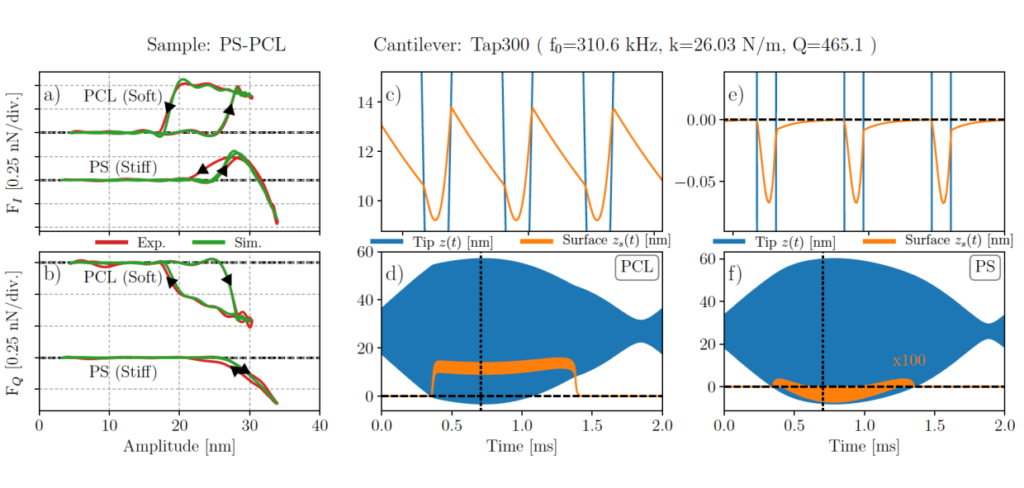
이동 표면 모델을 사용하여 시뮬레이션한 힘 적분 곡선은 실험 데이터와 매우 잘 일치한다. 시뮬레이션을 통해 AFM으로는 측정할 수 없는 표면 운동을 확인할 수 있다. 캔틸레버의 급격한 진동(파란색)과 표면 진동(주황색)의 포락선 시간 변화를 보면, 접착력이 연성 표면을 들어 올리는 것을 알 수 있다. 표면은 팁이 연속적으로 접촉하는 사이 완전히 이완될 시간이 없어, 시간 평균적으로 표면이 들어 올려진 상태가 되고 힘 사분면 곡선에서 히스테리시스가 발생한다.
Dynamic force quadratures and the moving surface model
The standard approach to quantitative AFM reconstructs tip-surface force as a function of tip position, the force-distance curve Fts(z)Fts(z). Through analysis of these force curves one tries to understand something about material properties. The reconstruction assumes that tip and sample forces are in quasi-static equilibrium, thus neglecting viscous forces proportional to tip velocity. Quasi-static force curves give a conservative tip-surface force Fcon(z)Fcon(z), which can only tell us about the elastic nature of the material.
In contrast, dynamic force quadratures capture both elastic and viscous forces. But the force quadrature curves do not display these forces as a function of tip position, rather they show the integrated force over one oscillation cycle of the cantilever. Dynamical Mechanical Analysis (DMA) uses this same type of cyclic force analysis to characterize viscoelastic materials such as polymers. However, in contrast to DMA, which usually works with fixed oscillation amplitude, ImAFM force quadrature curves show the elastic (conservative) force FI(A)FI(A) and the viscous (dissipative) force FQ(A)FQ(A) as functions of the amplitude AA.
The first video (below) simulates the force quadratures for an AFM tip oscillating in constant contact with the sample, as is the case with ‘contact resonance’ AFM. To make it simple, we assume a linear force-distance curve in the contact region (black curve, upper left panel). The lower left panel shows the tip position z(t)z(t) and tip-surface force Fts(t)Fts(t) as functions of time, plotted over one complete oscillation cycle. The relaxed position of the surface zs=0zs=0 is indicated (red line, lower left panel). For each oscillation cycle the conservative (elastic) force quadrature FIFI and the dissipative (viscous) force quadrature FQFQ are plotted. Play the video to show these evolve as the oscillation amplitude is ramped up and down.
Note that FQ=0FQ=0 at all amplitudes, because we simulate a purely elastic tip-surface interaction. Also notice that the oscillating tip-surface force and tip position are simultaneously in exact opposition, i.e. phase angle ππ with respect to one-another. The next video shows how this simulation changes when we add a linear velocity-dependent, or viscous tip-surface force.
힘-거리 곡선(좌측 상단 패널의 자홍색 선)은 더 이상 탐침 위치에 대한 단일값 함수가 아닙니다. 힘은 탐침 속도에 의해서도 영향을 받기 때문에, 점탄성 응답을 설명하는 유일한 힘-거리 곡선은 존재하지 않습니다. 팁의 진동은 힘의 진동에 비해 𝜋 보다 큰 위상각만큼 뒤처진다. 이 위상 지연의 탄젠트, 즉 DMA의 ‘손실 탄젠트’는 점탄성 재료를 특성화하는 데 흔히 사용되는 물리량이다.
점성(소산성) 팁-표면 상호작용은 0이 아닌 𝐹𝑄(𝐴)를 가집니다. 선형 점탄성 응답의 경우, 두 힘의 제곱합 곡선 모두 직선이며, 이들의 기울기를 통해 팁-표면 접촉의 탄성 강성과 점성 감쇠 계수를 구할 수 있습니다. 그러나 AFM에서는 팁이 표면을 두드리는 간헐적 접촉 상태에서 측정하는 경우가 많습니다. 다음 동영상은 AFM 힘 곡선 분석에 흔히 사용되는 DMT 모델을 통해 간헐적 접촉을 시뮬레이션합니다.
Short range van der Waals attraction cause rapid pulses of force when the tip when makes and breaks contact with the surface. The interaction model is a purely conservative force, so there is no dissipation and FQ(A)=0FQ(A)=0 at all amplitudes. Note that Fts(t)Fts(t) is symmetric in time with respect to the lower turning point of the oscillation, as expected for any conservative force model.
The next video shows how this picture changes when we add a viscous damping force to intermittent contact. We modify the DMT model with a viscous force that turns on when the tip is in contact with the surface, z<zsz<zs, where the surface position zs=0zs=0 remains fixed in time.
Again, the viscous nature of the interaction gives FQ(A)≠0FQ(A)=0. The force curve Fts(z)Fts(z) is not single-valued and Fts(t)Fts(t) is no longer time-symmetric, i.e. the approaching tip feels a different force than the retracting tip. However, for this model the force quadrature curves are single-valued: FI(A)FI(A) and FQ(A)FQ(A), are the same for increasing and decreasing amplitude. From their shape it is possible, under certain assumptions, to reconstruct a conservative force curve Fcon(z)Fcon(z) and viscous damping function η(z)η(z). But these functions of tip position do not capture the true nature of viscoelastic material response in dynamic AFM. Rather, the shape and relative magnitude of the force quadrature cures themselves provide the quantitative information we need to understand the mechanical properties of the material and its surface.
To clarify this point we simulate force quadratures with a moving surface model that takes in to account the dynamics of the tip, z(t)z(t), and the dynamics of a moving surface, zs(t)zs(t). The force between the tip and surface is given as a function of the tip-surface separation, s(t)=z(t)−zs(t)s(t)=z(t)−zs(t), and the rate of tip penetration s˙s˙. We assume simple linear functions of ss and s˙s˙ which, together with a fixed adhesion force, turn on instantly upon contact with the surface, s<0s<0.
The short-range adhesion force rapidly lifts the soft surface and the viscoelastic interaction gives a net force that starts out repulsive and changes to attractive during each tap. The surface relaxation time is longer than the period of oscillation, so the lifted surface does not relax to it’s equilibrium position before being lifted further with the next tap. The force quadrature curves are hysteretic: The amplitude at which the tip first touches the surface, is larger than the amplitude at which it stops touching the surface.
Hysteretic FI(A)FI(A) and FQ(A)FQ(A) are common on soft materials, having many different shapes depending on material parameters. Often the curves are well-explained with a simple piece-wise-linear viscoelastic moving surface model. As an example we show force quadrature curves measured on amorphous polycaprolactone (grey curves, right panels). Fitting the parameters of the moving surface model, we achieve excellent agreement with the simulated curves (blue curves, right panels). The video below shows several oscillation cycles at various points on the force quadrature curves. The measured cantilever motion and simulated surface motion are shown in both time and space (left panels) where the surface profile is assumed to look like a capillary meniscus. Such ‘solid capillarity’ is expected when the sharp tip interface with very large curvature meets the soft material interface with very low curvature.
Force quadrature curves are reconstructed from measured ImAFM data with no assumed model, making them ideal primitive ‘force curves’ for quantitative analysis of dynamic AFM. Understanding their shape and magnitude leads to a deeper understanding of nanometer-scale viscoelastic impact, allowing us to develop models and extract parameters that describe physically meaningful material properties. You can read more about the moving surface model in our publication.
This video tutorial was prepared by David Haviland and Per Anders Thorén at Nanostructure Physics, KTH. The sample was provided by Phillipe Leclère at the University of Mons. You are free to copy and show these videos in your teaching and research presentations.