Tutorial: Multifrequency sweeping with MLA-3
Prerequisites:
- An Intermodulation Products MLA-3.
- GUI software installed.
The Problem: The “Stepping” Bottleneck
In standard impedance analysis or frequency response measurements, the instrument typically performs a “serial” sweep. It generates one frequency, measures the response, moves to the next frequency, and repeats. While accurate, this stepping process creates significant dead time, making high-resolution sweeps slow and tedious.
The Solution: Multifrequency Sweeping
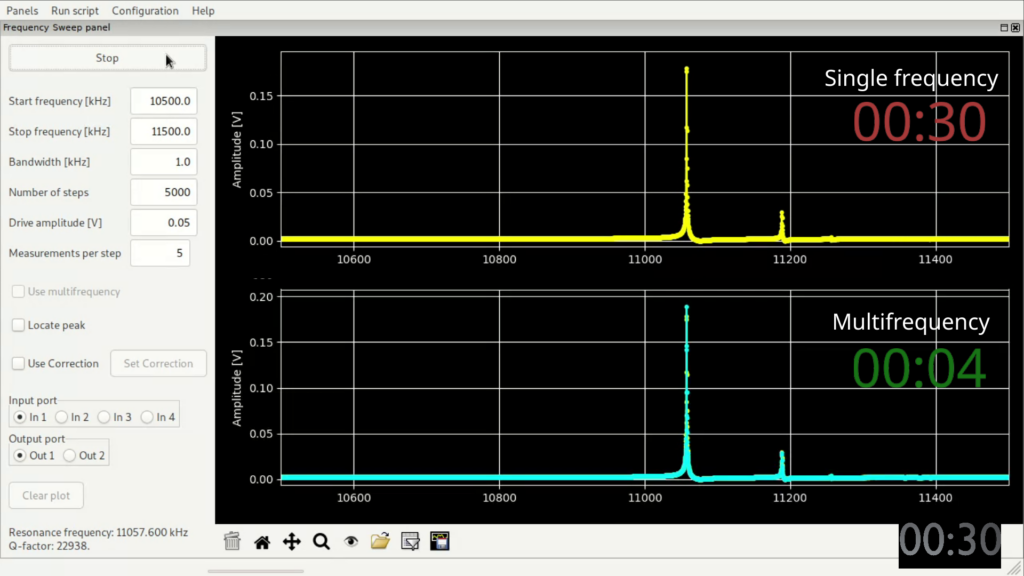
Because the MLA is capable of generating and analyzing multiple frequencies simultaneously (a “frequency comb”), you do not need to measure one point at a time. By activating the Multifrequency option, the MLA fills the measurement band with multiple excitation tones, acquiring dozens of data points in the same time it usually takes to measure one.
This results in a speed increase of roughly 30x—with zero compromise on frequency resolution or Signal-to-Noise Ratio (SNR).
Step-by-Step Implementation
- Open the Frequency sweep pannel in the GUI. Set your start frequency, stop frequency, and the number of points (resolution) as you normally would for a standard sweep.
- Activate the Multifrequency Mode. You will see a toggle labeled Use multifrequency.
- Press the Run sweep button.
It is that easy!
Note: For a liner system, the response in both cases will be identical. If you are probing a non-linear system, multifrequency excitation will activate the non-linear interactin between the different tones.